Joe and Biddy’s marriage
Great ExpectationsJoe and Biddy’s marriage is the culmination of their shared life in the forge household and a decisive reordering of Pip’s idea of home. Their union, revealed on the day Pip returns to the village, makes a domestic future without him visible: Joe and Biddy have built a family, and their kindness welcomes Pip back without pretending that his earlier distance never mattered.
From household companions to spouses
Before their marriage, Joe and Biddy occupy the same intimate domestic world as Pip, but his changing fortunes alter how he sees them. When Pip learns of his expectations, Joe and Biddy resume their cheerful ease, while Pip becomes gloomy and suspects that his dissatisfaction may be with himself. Their talk of his departure and of what they will do without him makes him feel offended, although neither has expressed mistrust. His shame at the ordinary life of the forge and his pursuit of gentility thus estrange him from people whose regard remains warm.
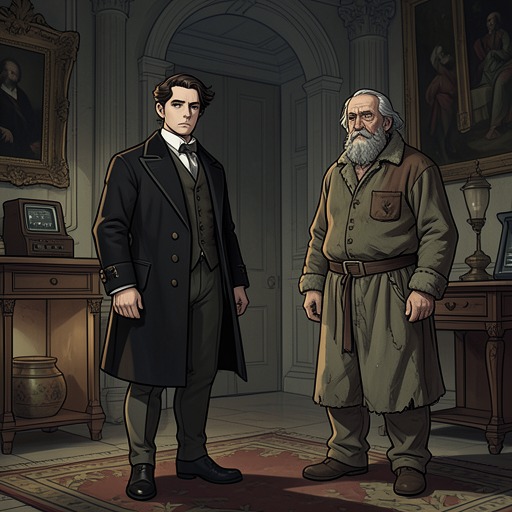
That estrangement is not presented as a failure of affection on Joe and Biddy’s part. On a later return, Pip finds the forge closed and silent, but the house is inhabited: white curtains move at the open parlour window, and flowers brighten it. Joe and Biddy then appear together, arm in arm. The scene’s orderly signs of domestic life replace Pip’s earlier image of the forge as an oppressive, common place; what he encounters is a home cared for and shared.
Marriage revealed on Pip’s return
Biddy announces that the day is her wedding day and that she has married Joe. The news comes as a joyful surprise to Pip, who has arrived by accident. He has come back worn and pale, while Biddy appears fresh and pleasant; their reunion brings both to tears. The marriage does not turn the encounter into a rebuke. Joe and Biddy are delighted that Pip has come, proud and touched to see him, and glad that his unexpected arrival completes their happiness.
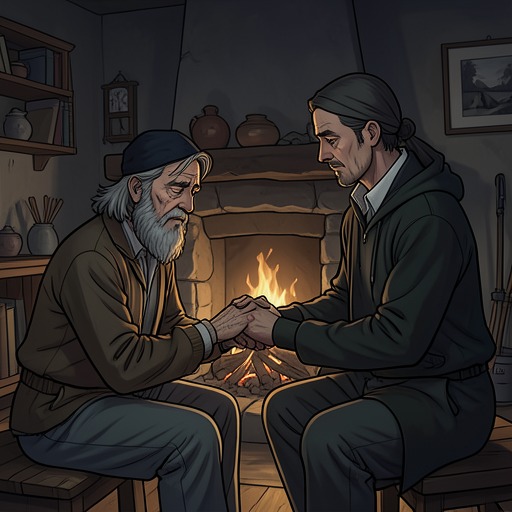
The kitchen, once the setting of Pip’s everyday life and later an object of class shame, becomes the place where he is received into the couple’s celebration. He lays his head on the old deal table while Biddy holds his hand and Joe touches his shoulder. Their gestures make welcome physical and immediate. Pip is thankful that, during his illness, he did not voice a final hope to Joe that would have burdened their reunion; the marriage also confirms that Joe’s and Biddy’s future has moved forward beyond Pip’s unspoken expectations.
A family life continuing beyond the village
Eleven years pass before Pip sees Joe and Biddy again. In December, after dark, he quietly opens the old kitchen door and looks in unseen. Joe sits by the fire, hale and strong though a little grey. Beside him, a child occupies Pip’s old stool, and Joe explains that they named the boy Pip for his sake, hoping he might grow a little like him. Their son’s name acknowledges Pip’s place in their affection without making him the center of their household.
Pip joins the child by the fire and takes him for a walk the following morning. They visit the churchyard, where the boy shows him the tombstone commemorating Philip Pirrip and Georgiana, Joe’s sister. The family scene therefore holds continuity and loss together: Joe and Biddy have a living child, while the gravestone preserves the memory of Pip’s parents. When Pip later asks Biddy to give him the child one day, or at least lend him, she gently refuses and tells him that he must marry. Their exchange registers the closeness of the old friendship, but also Biddy’s clear understanding that Pip cannot claim a place in their family by making their son a substitute for a future of his own.
The marriage’s significance for Pip
The marriage offers a counterpoint to the status and romance Pip once imagined around Estella. As a young man, he cast the ruined Satis House as the setting for a heroic task: he pictured himself restoring it and marrying its adopted girl. His adult narration later recognizes that he loved Estella because he found her irresistible, despite the damage that love brought to his peace and hopes. Joe and Biddy’s life, by contrast, is not built on Pip’s romantic fantasy or social ascent. Its meaning is shown in shared domestic space, mutual care, and a family that remains welcoming without waiting for him.
Pip’s return also makes the moral consequence of his earlier conduct legible. He remembers Joe’s tact and kindness during his recovery, and understands that as he grew stronger, Joe became less at ease because Pip had given him reason to fear that prosperity would make him cold and cause him to cast Joe off. The marriage does not erase that history; it reveals the durable affection that survived it. In the closing scene, the child named Pip carries that affection into the next generation, while Biddy’s gentle insistence that the older Pip should marry marks the boundary between his beloved place in their home and the life he must shape for himself.